
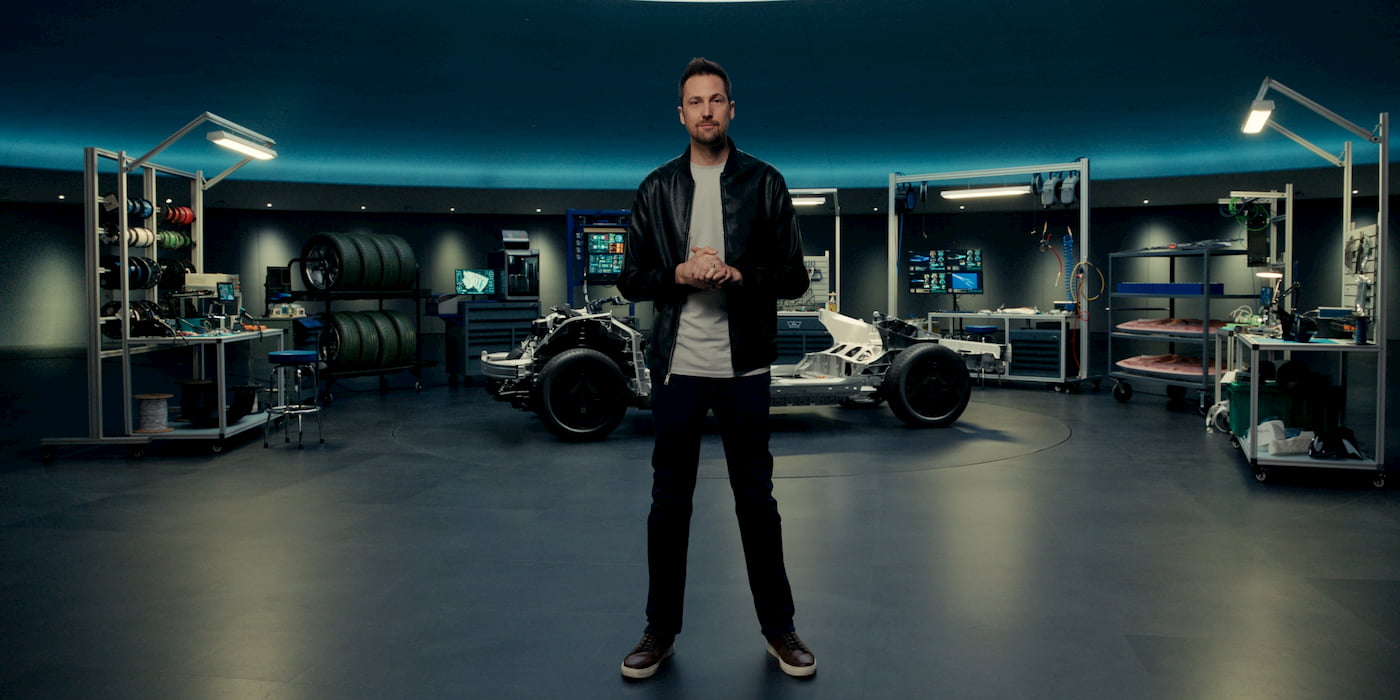
Ford offered a closer look at how its most important project ever, the Universal EV Platform, will drastically cut costs and deliver more driving range. The first vehicle based on the platform will be a mid-size electric pickup, which Ford said will start at around $30,000.
Ford bets on new UEV platform for more affordable EVs
After introducing the Universal EV (UEV) Platform for the first time last year, Ford’s CEO Jim Farley said the company was done with the “good college tries” from its crosstown rivals.
The UEV is “one of the most audacious and important projects in Ford’s history,” according to Farley. With the first UEV-based vehicle, a mid-size electric pickup, due out next year, Ford revealed a few more details about what to expect.
One of the key priorities is improving efficiency through aerodynamics and smaller batteries. More than half of the aerodynamics team came from the Formula 1 world, Ford said.
As a result, the company claims its mid-size electric truck’s aerodynamic efficiency is 15% better than “any other pickup truck on the market today.” In other words, the improvements result in longer range and lower costs.
If the same battery were used on the most aerodynamically efficient mid-size gas truck in the US, Ford said its new pickup would deliver nearly 50 miles or 15% more driving range. At highway speeds, it offers a 30% improvement.
Design isn’t the only thing that Ford aims to improve the range. While, for the most part, the solution to increase driving range has been to increase battery size, doing so adds weight and therefore reduces efficiency.
The battery is “the most crucial component to tackle affordability,” Ford said, since it accounts for about 40% of the vehicle costs and roughly 25% of its weight.
Ford will be the first automaker in the US to build prismatic lithium iron phosphate (LFP) batteries. Not only are LFP batteries cheaper, but Ford said the prismatic design will unlock additional savings while creating more interior space.
The “skunkworks” team tasked with developing range, efficiency, and performance metrics coined the term “bounties” to evaluate trade-offs.
For example, one of those bounties was the roofline. Ford designed it with a teardrop profile that creates a “virtual surface” for air to flow over. Or, in Ford’s words, “To the air, it is no longer a truck, but a sleek, aerodynamic silhouette.”
Top comment by K G
I have a 2022 PRO. Even paying $7500 over sticker I paid $55k. The most I had ever spent on a vehicle, but the most vehicle I could get for the least amount of money at the time. I drove a 2001 F250 7.3 diesel for 20 years before this. I was even kind of anti EV. But diesel was at $6 a gallon at the time, and as a diesel lover, I was also a big fan of torque, so 775 foot pounds sounded incredible. I test drove one and the rest is history. 3.5 years, 50k miles, not a single penny spent on this vehicle. The only time it has been in the shop was to rotate the tires ONE time! And I'm still driving on those original tires. Even the original 12v battery. Best freaking truck I've ever owned. All the time and money I have saved not maintaining my diesel is tremendous. $3k alone in oil changes saved!!! Plus 90% of my charging is done at home, so the fuel savings is ridiculous too. This truck basically pays for itself by having me not drive my diesel. I should also add that the Lightning also tows 10k lbs way better than the diesel. I was so surprised by that fact, that it took me over 2 years to even try towing with it over the diesel. Now I don't even use the diesel for anything.
Moving to the underbody. While the underbody can be a drag on aerodynamics, Ford saw it as an opportunity. It treated it as they would in Formula 1, making the bolts flush with the floor and designing the underbody to direct air around the tires and suspension.
By “hiding” the rear wheels, Ford said it added an additional 4.5 miles of range. It’s the little improvements that add up for overall vehicle efficiency.
Ford has said that the mid-size pickup will have a lower cost of ownership than a Tesla Model Y and offer more interior space than a Toyota RAV4.
New UEV-based vehicles will be built at Ford’s Louisville Assembly Plant. For the first time, Ford is using large unicastings, which it said reduces the number of parts from 146 on the current Maverick, to just two in the mid-size electric pickup.


FTC: We use income earning auto affiliate links. More.


Comments